
Having traveled in China and Taiwan for the first time since 2020, I have some thoughts. The past 4,5 weeks showed me many things that remain the same, have changed hugely or did not notice as much before. I will put some of these into words in my next few posts.
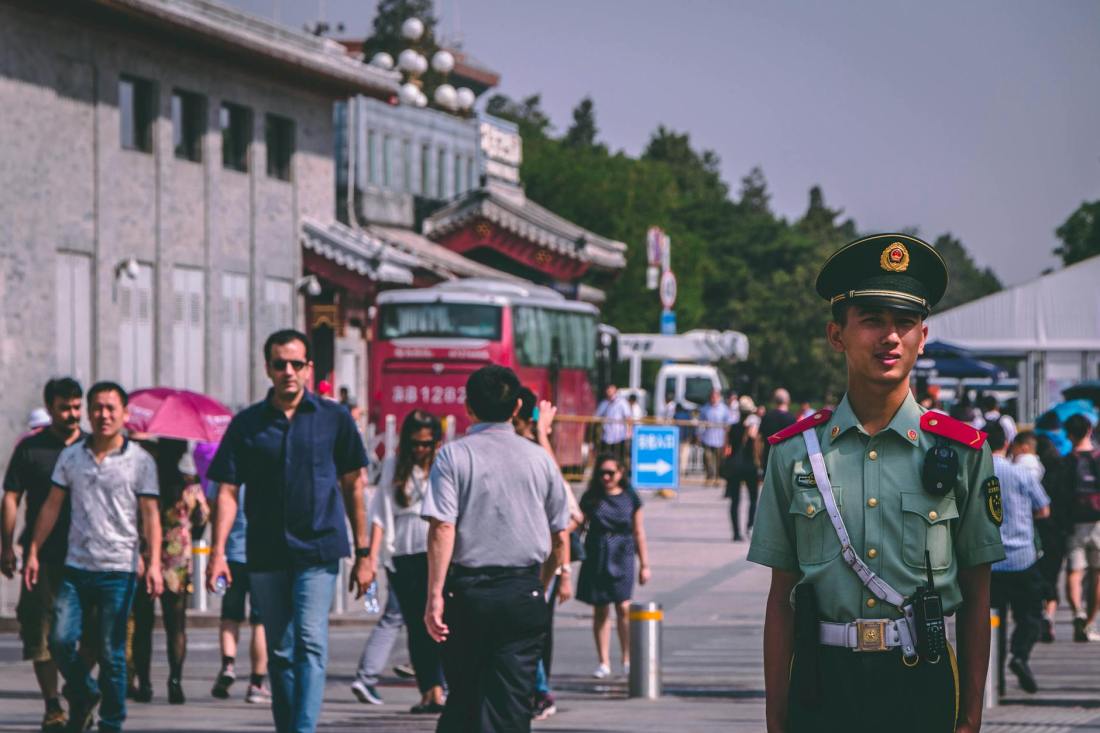
This time around, it definitely felt like security was increased. Especially at the metro stations and in the metro as well. Guards were more actively checking up on substances, items and eating in the metro. Traffic lights with cameras were more common, snapping shots of jaywalkers. And identification was necessary way more often than before.
Security was also the aspect that set Beijing apart the most clearly. Of course it did not help that we were there at the tail end of the national holiday, which naturally meant increased security and guards around the Forbidden City and Tian’anmen Square. But I did not expect my boyfriend to be held back because they found some of his (work) papers suspicious(?). I guess it was a good thing the Chinese for ‘patent’ did not come up in my head immediately, since that probably would not have helped the case.
Anyway, I did not think the already quite performative security could be pushed even further. I guess it did not really surprise me that much, and only in Beijing did they have guards walking around in metro carts. I was surprised that one of them told me I was not allowed to eat, but it comforted me that nobody batted an eye when I finished my corn after he got off.
Security at metro stations did increase though, and was a bit more strict. Liquid checks were quite common in all cities, almost always being asked to take a sip or occasionally having my bottle being put on a machine that probably identified it as safe. We were also asked more specifically about ‘dangerous objects’ such as pocket knives, which my boyfriend ended up packing in the top of his backpack for easy access. At the same time, anytime we needed to show or prove something, the guards seemed kind of at a loss at what was supposed to happen next. Even my excuses were often not listened to and they seemed to just let us go with the knowledge that checking us was the most important.
I was surprised however, how much we had to identify ourselves this time around. Granted, Chinese IDs have become more ubiquitous as convenient, personalized ways to gain access to all sorts of attractions. At the same time, the system was a lot less seamless for foreign passport holders, so we spent some time with guards looking over our shoulder as we filled out perfunctory forms that did not generate QR codes for us, and holding up our passports to get entry if we could not scan.
Lastly, I received some additional scrutiny at the customs border almost every time we passed. Granted, I have about 5 expired Chinese visa and about 25 stamps in random order in my passport so that confusion is fully understandable. However, it also seems that some of my information was not always available (like the Chinese name I used when living in China) or that my passport could for some reason not be scanned. I was happy however to not get questioned about the quirky combination of a Chinese face and Dutch passport.
In the end, China definitely interprets and carries out security quite differently than we tend to view it in the West. Where we may specifically add guards under certain circumstances, in China they are present in many places, but often asleep. Something my boyfriend also notices about many of the police officers he spotted. There may be 6 security guards at the metro entrance, but 2 of them are looking at their phone and the other 4 are almost fighting to get to tell the passengers what to do or to scan them. The fact that perfunctory security measures still seem to be the focus, at least in the big cities and for the general population, is a postive. Relatively.
 Bitesized Writing